Showing posts with label triangle. Show all posts

Thursday, August 7, 2025

Sliding Rectangles and the Lam-Ca Construction

In the quiet elegance of geometric construction, sometimes a simple configuration reveals a profound truth. This post explores one such configuration, part of a legacy left behind by my late Vietnamese friend, Nguyen Tan Tai, who referred to it as the Lam-Ca construction — from the Vietnamese words meaning “do it all.” And that’s exactly what these diagrams aim to do: to explain, prove, and illuminate all at once.

What Nguyen Tan Tai created is more than a diagram: it is a visual proof that brings together trigonometric identities, reciprocal relationships, and the power of constant area.


Click the image or open the interactive Geogebra diagram here.

Unit Diameter Circle Instead of Unit Radius

Most trigonometric constructions begin with a circle with radius 1, where sines and cosines are represented as vertical and horizontal projections of a point on the circle. But in this configuration, the circle has unit diameter.

In a circle of unit diameter:

  • The angle α is inscribed.

  • The opposite chord has a length equal to sin α.

  • For an inscribed right triangle (i.e. with hypotenuse = 1) The adjacent chord has a length equal to cos α.

  • The projection of the opposite and adjacent chords on the hypotenuse have respective lengths sin²α and cos²α.

We therefore use chord lengths derived directly from the geometry of the circle. They reflect the sine and cosine values as segments formed within the circle, preserving symmetry and proportions naturally. The squares (blue and red) and rectangles (green and orange) of the upper part of the figure illustrate this nicely. I have already posted this construction in a previous post.

The Insightful Twist: Sliding Rectangles of Constant Area

What Nguyen Tan Tai introduced was an original twist on the classical representation of the inscribed rectangle: instead of constructing squares on the chord segments, he formed rectangles (shown in grey in the lower part of the figure) defined by:

  • Left rectangle: one side is sin α, the other is 1/sin α

  • Right rectangle: one side is cos α, the other is 1/cos α

The result? Each rectangle has a constant area of exactly 1, even as the angle α changes. In this way we see a whole family of unit-area rectangles. Their lower vertices trace a horizontal line anchored at y = –1. The shape of the rectangle dynamically adapts, while its area remains invariant.

Why This Matters

This construction transforms reciprocal trigonometric identities from abstract formulas into tangible, visual objects. The construction reveals them as side lengths in a dynamic geometry.

This approach:

  • Makes reciprocal relationships intuitive

  • Shows how geometry can express trigonometry with visual clarity

  • Bridges sine and cosine with their multiplicative inverses

  • Highlights a rarely explored link between circular geometry and constant-area transformations

The Lam-Ca Perspective

What makes the Lam-Ca construction special is its simplicity: no coordinates, no algebra, just pure geometry. Using circles of unit diameter and basic projections, Nguyen Tan Tai’s approach recovers deep identities from nothing but straightedge-and-compass logic.

This is not just a visual trick. It’s a philosophy: that geometry, when done right, can do it all.

A Quiet Tribute

To our knowledge, this method of constructing unit-area rectangles with sides defined by chord-based trigonometric values and their reciprocals has not been formally documented elsewhere. It stands as a tribute to Nguyen Tan Tai’s creativity and insight—a quietly powerful expression of geometry’s poetic depth.

This visualization is a piece of his legacy, and I’m honored to share it. What if some of the most beautiful trigonometric identities could be seen rather than derived algebraically?


In the next post, I’ll extend this same diagram to reveal tripling angle identities like cos(3α) and sin(3α) — all through sliding rectangles and simple symmetry. Stay tuned.

Tuesday, March 25, 2025

Unveiling Pythagoras: How Circle-Based Area Transformations Reveal the Truth

I recently had a discussion about the Pythagorean theorem and how to understand it better. I realized that the role of the circle as a fundamental element is often underrated. You can hardly find any proof where the right-angled triangle is placed within a circle to support the reasoning. Instead, the triangles are usually presented in a plane without reference. However, when you position the triangle inside a circle, it becomes much easier to visualize how the relationship holds as the right-angle vertex moves along the circle.

The key idea to understand is that in the following image, for a unit square, the green and blue areas are always equal to cos²(α), while the orange and red areas correspond to sin²(α). It is evident that the square, with an area of 1, is the sum of its left and right sections.

By opening the GeoGebra resource [Pythagoras proof in a circle (opens a new tab)], you can slide the right-angle vertex (red point) anywhere along the upper half of the circle. 


Sunday, November 27, 2016

Law of sines, chords and similar triangles

Recently, I picked up my pencil and notebook and started to draw circles and triangles again. Swiftly, by drawing similar triangles circumscribed by circles, I got interested in their proportionalities, leading me to the law of sines.
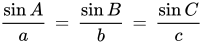
For any triangle ABC, where a is the length of the side opposite to angle A, b the length of the side opposite to angle B and c the length of the side opposite to angle C, the law of sines states that:

where d is the diameter of the circle circumscribing ABC, as traced in Figure 1.

Figure 1: Arbitrary triangle ABC circumscribed in its circle with diameter d

My search in literature and web left me somewhat frustrated, for different reasons:
  • one often omits to mention the diameter d, in its statement and even in its proof,
  • one rarely develops this very elegant statement to closely related geometrical principles, like the intercept theorem or similarity transformations
  • the historical background of the law of sines couldn't be checked easily from its original sources.

Why we should not leave out the diameter d of the circumscribed circle

The law is often stated in the reciprocal form and leaving out the diameter.
{\displaystyle {\frac {\sin A}{a}}\,=\,{\frac {\sin B}{b}}\,=\,{\frac {\sin C}{c}}}
while in this case, we should really write:
{\displaystyle {\frac {\sin A}{a}}\,=\,{\frac {\sin B}{b}}\,=\,{\frac {\sin C}{c}}\,=\,{\frac {\sin 90^{\circ }}{d}}}

We should have in mind that the sine of an angle is the length of the chord of the same angle inscribed in a circle of unit diameter, as you can teach children with spaghetti.

The law of sines can be understood as a statement relative to proportions between:
- chords traced in a circle with unit diameter,
- and similar chords traced in a circle scaled up by a factor d.

For example, we could trace a circle with unit diameter tangent at A inside the original circle, see Figure 2. With the notation used in this figure, the scale factor d can then be read out easily as different ratios: d = a/a0 = b/b0 = c/c0.
Figure 2: Triangle ABC and tangent unit circle in A
This is one of the intuitions behind the law of sines. and we could view it as a natural law of similarity: "Corresponding lines in similar figures are in proportion, and corresponding angles in similar figures have the same measure."

Of course, if we want to set up a formal proof, we can deduce it from other laws :

1. The inscribed angle:
When inscribed in the same circle, all angles, subtending arcs of the same measure, are equal.
In Figure 2, BC being of the same length as DE, the angles  and are equal.
Therefore sin A = "opposite side over hypotenuse" = a/d.
Q.E.D.
This is also visually explained at "Better explained" or for those who read French "Blog de maths".

2. Central and inscribed angle, with Pythagoras:
This proof involves an additional notion: the central angle.
One can find it on other good sites:
Pat Ballew's blog
Math less travelled

3. Using the height of the triangle
This proof comes in different variations, either through expressing the area respective to the different heights (as given on wikipedia), either through expressing one height as ratios with two different sides (this is the academic proof, example here). Not my favorite one, as it doesn't give any insight in the scale factor d. If you don't need to pass exams, but doing math for fun, please forget this one!

Homothetic transformation with scale factor d

A homothety is a transformation where a geometric entity is transformed a similar version with a scale factor. In Figure 2, we represented the homothety from a circle of unit diameter towards a circle with diameter d. The inscribed lines, triangles and other polygons undergo the same scaling. And thus, we can complement the law of sines with a list of other ratios that also equal d.
In Figure 3, I draw the unit circle at an arbitrary place in space. Then joining similar points. The intersection of the lines is the homothetic center O.

Figure 3: Triangle ABC as a homothety from A0B0C0 centered in O
Now, any line passing through O and intersecting with the small circle, will also intersect with the large circle at similar points (example D and D0, C and C0, B and B0, etc.) The ratios of various line segments that are created if we trace pairs of parallels from these points will be the same, for example:
CD/C0D0 = BD/B0D0 = AD/A0D0 = OD/OD0 = d
This is the intercept theorem.

Curiously, when searching on the web, both laws, the law of sines and the intercept theorem aren't often associated, while they are, in my opinion, stemming from the same basic principle of conservation of proportions.

I refer to two interesting posts that are related:
At Math is fun: Theorems about Similar Triangles
At Girls' Angle: Do you believe this?

Historical background

And in the history of geometry?

I've looked up sources about Apollonius of Perga, Ptolemy, Regiomontanus, Viete, Coignet (http://logica.ugent.be/albrecht/math/bosmans/R007.pdf), Simson (Elements of the conic sections), Jakob Steiner, but couldn't always find the original sources. I would be interested to have access to them.

The same for a paper by Richard Brandon Kershner. "The Law of Sines and Law of Cosines for Polygons." Mathematics Magazine, vol. 44, no. 3, 1971, pp. 150–153. www.jstor.org/stable/2688227.

Sunday, March 27, 2011

Morley triangle derived from the tripling of an angle

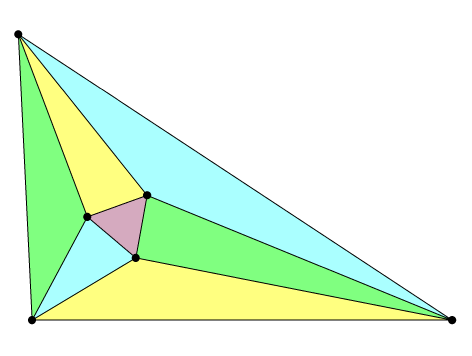
Morley equilateral triangle at the intersection of the trisectors
(from Wikimedia Commons)
In a previous post, I mentioned Morley's miracle: an equilateral triangle appearing at the points of intersection of the angle trisectors of any triangle.

Frank Morley was an excellent teacher and chess player (see some more about him at Pat'sBlog). If he had lived today, I like to think of him having his own blog communicating about his passion for math and chess, submitting his recreational problems. If he hadn't discovered the equilateral triangle at the intersection of trisectors, it's probable that this theorem would still be unknown. Trisection of angles is a controversial subject for research, especially among academia, where it is associated with suspicion of crankiness (see Underwood Dudley's book about trisectors). A pity... because trying to understand how to divide angles is a "natural" question, of which we shouldn't be ashamed, provided that we modestly take into account what has been found by other people.

All the proofs of Morley's theorem that I know of start with a result: an equilateral triangle or a triangle already drawn with its trisectors (see the different proofs referenced on the very complete French site Abracadabri or at the end of Alexander Bogolmony's Cut the Knot site). In this sense, they are backward proofs, which keeps some mystery about the physical origin of the equilateral triangle. I tried something different, a bit similar in spirit to my Archimedes tripling circle: How can we multiply an angle by 3, from which would result a Morley triangle embedded in a triangle of any shape? So here follows an alternative forward proof for Morley's theorem.

Step 1: I start with a circle in which I inscribe an angle α inferior to 60°. The lines are intercepting an arc on the circle.

Step 2: I duplicate the angle by tracing a little circle centered at one of the endpoints of the arc and with radius the chord of that arc. I repeat the same operation to triplicate the angle (see Figure 1).
Step 3: When two circles of equal size and common radius intersect, two equilateral triangles appear, so I draw both of them: Figure 2.
Step 4: I draw supplementary equilateral triangles at both sides, with the help of the intersections of the circles and the outer lines of the triplicate angle, see Figure 3.
Step 5: The magenta colored equilateral triangle is the Morley triangle of the arbitrary triangle we are looking for. The Morley triangle is a pivotal triangle, so the other vertices of the arbitrary triangle can be found through symmetric construction of the initial inscribing circle centered towards the other sides of the Morley triangle, see the red circles at Figure 4.
Step 6: I complete the figure with the triplicated angles β and γ in the red inscribing circles. The sides of the searched triangle are the outer lines of the triplicated angles, see Figure 5.
With this tripling angle construction, we always obtain an equilateral triangle at the intersection of the trisectors of a triangle. When the initial vertex is moved on the initial inscribing circle, all triangle shapes can be generated for any initial angle α between 0 and 60°, which proves the Morley theorem for any triangle.

Saturday, August 28, 2010

Alternative Pythagorean quadruples and other extensions to Pythagoras theorem

The vertices of an arbitrary triangle can be disposed onto two concentric circles such that the base is the diameter of the first circle (which I call the base circle) and the opposite vertex is on the second circle (which I call the leg circle). As there are three bases, there are generally three ways to arrange this setting. I mentioned in my preceding post that we can apply the Pythagorean-like relation a²+b²=c²±2t² to this triangle, where c is its base, a and b are the legs and t is the tangent to the inner circle emanating from the outer circle. For clarity, I reproduce an illustrative figure from my preceding post, for the case where the inner circle is the base circle.

Now, like for the classical Pythagoras relation, there are many features that can be investigated regarding this alternative relation. For example, I would like to better understand the relation of this 2D formula with the Cartesian 3D variant of Pythagoras: x²+y²+z²=d², which is analogous to the case where the leg circle is smaller than the base circle (see Figure 5c of preceding post). Another interesting aspect is the fact that the square of the tangent t² (multiplied by π) determines the area of the annular ring delimited by the base and the leg circles, as stated by Mamikon Mnatsakanian. This fact offers possibilities for areal representations of the squares or circles related to the sides of the arbitrary triangle, like we are acquainted to do with the squares related to the sides of a right triangle. Also, what would be interesting to develop is its relation with the law of cosines (as noticed by Pat Ballew) and the angle subtended by sides a and b. I guess this will leave enough stuff for future posts or conversations, or even papers in specialized journals.

As a conclusion, let me mention Pythagorean numerological features which provide stuff for entertaining puzzles. Maybe you know the Pythagorean triples, those sets of integer numbers (n,m,l) that verify n²+m²=l² and of which (3,4,5) is the simplest instance. The 3D Pythagoras relation allows an extension to Pythagorean quadruples, sets of integer numbers (n,m,l,k) that satisfy n²+m²+l²=k² and of which (1,2,2,3) is the simplest instance. I couldn't resist to look for some integer quadruples that satisfy a²+b²=c²+2t². Among them I found two nice quadruples with successive a,b,c :

(7,8,9,4) for which 7² + 8² = 9² + 2 × 4² = 113

(35,36,37,24) for which 35² + 36² = 37² + 2 × 24² = 2521

Sunday, August 15, 2010

A Pythagorean relation for any triangle?

Physics makes extensive use of the Pythagorean law relating the squares of the sides of a right triangle. The well-known a² + b² = c² relation is of special interest for the determination of distances and lengths of vectors, but also for energy conservation laws and Lorentz transformations. There are various relations that resemble the Pythagoras law, but none of them seems to have the usefulness of Pythagoras’ original one, as well as the “beauty” originating from its sole quadratic terms. When the vertex opposite to the hypotenuse runs on the circle determined by the right triangle, we have the Pythagoras relation illustrated in Figure 1.
Some time ago, I was made aware of another interesting Pythagorean law, discovered by Nguyen Tan Tai and which I mentioned in a previous post. For any triangle with sides a, b and c, if the vertex opposite to the base (say c) runs on any fixed circle centered at the center of c, we have the relation:

a² + b² = c² + constant

In order to have a better understanding of this quadratic relation, I tried to re-derive it in my own mental representation. I will call the fixed circle with the running vertex C the “leg circle”, because it is determined by the vertex that is common to legs AC and BC of the triangle (see Figure 2).


When the leg circle is larger than the base circle, the legs AC and BC intersect the base circle and we can decompose the arbitrary triangle into two right triangles, for example as illustrated in Figure 3, the right triangles ABD and BCD.


With the Pythagoras relation we than have:

AC² + BC² = (AD + CD)² + BC²
= (AD² + CD² + 2.AD.CD) + (BD² + CD²)
= AD² + BD² + 2.CD² + 2.AD.CD
= (AD² + BD²) + 2.(AD + CD).CD
= AB² + 2.AC.CD

But the product AC.CD is the power of point C with respect to the base circle, i.e. for every point C on the leg circle, AC.CD is constant and equal to the square of the tangent ray CT (see Figure 4).


If we use another notation, AC = a, BC = b, AB = c and CT = t, the relation becomes a nice equation with only quadratic terms:

a² + b² = c² + t² + t²

One can verify that if the leg circle has same size as the base circle, we retrieve the original Pythagoras relation :

a² + b² = c²

And if the leg circle is smaller than the base circle, we have:

a² + b² + t² + t² = c²

where t is now the tangent ray to the leg circle emanating from any point of the base circle.

We thus have a Pythagoras-like relation for any triangle given its base and leg circles, as illustrated by Figures 5a, 5b and 5c.


Sunday, June 6, 2010

Lost theorem about angular proportions

Last week, I came across a so called missing theorem about angular proportions in a triangle, discovered (or rediscovered) by Leon Romain. This triangle construction is presented by user Linelites on youtube.

For such a "Romain triangle", the missing theorem states that, if one of the inner angles is twice another inner angle, one has the property a² = bc +c², where a, b and c are outlined in Figure 1.


The sine chord pattern presented in the Teaching sine function with spaghetti provides helpful insights for the missing theorem. In this pattern, all angles at the intersection of chords are integer multiples of a chosen unit angle or its complement, modulo 90°. All segment lengths in this pattern can therefore be written as sums or differences of cosine and sine products and ratios of that angle. Figure 2 pictures some measures of sine chords in a circle of unit diameter, for an arbitrary angle θ.


Figure 3 shows a Romain triangle for angle α in this pattern. There are numerous other Romain triangles in this pattern. Can you figure them out? With the help of the measures pictured in Figure 2, one can follow visually the elements of a proof for the missing theorem.


Side b is the sine of the chosen angle θ (Figure 4):

b = sinθ


Side c times sin3θ equals b times sinθ (Figure 5):

c = sin²θ/sin3θ


Side a equals b cosθ minus c cos3θ (Figure 6)

a = sinθ cosθ - sin²θ cos3θ /sin3θ


Working out a² and bc +c², one finds that they are both equal to 2 sin²θ cosθ / sin3θ.

The interesting thing is that the sine chord pattern hosts plenty of "missing theorems" about angular proportions, which are only waiting to be (re)discovered.

______________________
Update (June 7, 2010): I corrected Figure 6, which held a wrong term.

Sunday, March 28, 2010

Wallis product for nested equilateral triangles


I'm discovering the Wallis product thanks to an approach involving geometry of areas. In order to relate that to what has already been written on the subject, here are some works which I would like to study in the coming time:
Maybe you have other suggestions on this subject.

Meanwhile, I tried to draw equilateral triangles in the exhaustion scheme of nested circles. We start from the concentric rings of same area as described in Figure 4 of the Variations of circular area division into equal parts post. Remember the inner circle has radius 1 and area π. Each subsequent Nth circle has radius square root of N (noted √N) and area Nπ. Then we can draw an equilateral triangle whose sides are tangent to the first circle. The neat thing about this procedure is that we can read out the pertaining numerical values right on the figure. Figure 1 shows us that the area of the equilateral triangle is 3√3. So the ratio between the outscribed equilateral triangle area and the circle area is equal to 3√3/π.

By drawing equilateral triangles tangent to circles of incrementing area Nπ, we discover the nested equal area division for equilateral triangles: the area between each equilateral triangle is equal to 3√3 (see Figure 2, you can click on the figure to view it enlarged). Among other interesting features, this figure contains the table of 4. For each triangle outscribing a circle of radius √N, its vertices are located on the circle of order 4×N.


If we outscribe alternately a circle, a triangle, a circle, a triangle, a circle, etc., the circles (and the vertices of the triangles) go through the subsequent powers of 4, see Figure 3. By changing the form of the triangle, we have access to other tables and powers. It seems there are plenty of properties that are hidden in this structure.


Now, we can try the Wallis exhaustion scheme on the nested circle and triangle structure. The procedure apparently goes something like:
Step 1. Draw the initial circle and triangle with area ratio 3√3/4π.
Step 2. A better fit would be to inscribe both figures in higher orders of the nested structure. But the area of the triangle is too small with respect to the circle. So we must enlarge the area of the triangle more than the circle. We enlarge the area of the triangle by 3 while leaving unchanged the area of the circle. This is illustrated in the figure below.
Step 3. But now the area of the triangle is too large with respect to the circular area. So for this fit, we must enlarge the area of the triangle a little less than the area of the circle. We therefore enlarge the area of the triangle by 3, while enlarging the area of the circle by 4, as illustrated below.
Step 4. But now the area of the triangle is too small with respect to the circular area. So for the next fit, we must enlarge the area of the triangle a little more than the area of the circle. We therefore enlarge the area of the circle by 6, while enlarging the area of the circle by 5, as illustrated below.
This exhaustion scheme that makes the area of equilateral triangles alternately larger, smaller, larger, smaller, etc... than the circular area can be written as:
This formula corresponds to an infinite product approximating π, which I've found in a French book Le fascinant nombre π by Jean-Paul Delahaye but I couldn't find it mentioned elsewhere. As approximation method, it is about twice as fast as Wallis' original product. This equilateral triangle exhaustion product is probably a special case in a large family of Wallis products, each of which pertaining to a particular geometrical configuration from which one tries to approximate π. The starting and recurrence conditions depend on the form and the initial area ratio between the polygon and the circle. The rules governing this exhaustion scheme in the general case still elude me.

Sunday, January 17, 2010

Pythagoras extended


I came across an interesting Almost Pythagoras relation at Pat'sBlog. It says that for any triangle ABC with median AM drawn from vertex A, we have the general relation:

AB² + AC² = BM² + AM² + MC² + AM².

This relation can be proven with the law of cosines.

I like the alternative proof which is derived from the fact that for any triangle ABC:

AB² + AC² = constant,

if point A is located on a circle concentric with the circle of diameter BC (see Figure 1).


A proof of this important (and practically unknown) triangle theorem is given by Nguyen Tan Tai at one of his pages.

Therefore, from Figure 1, we can draw the isosceles triangle A'BC of Figure 2 with AB² + AC² = A'B² + A'C² and median A'M = AM.

The relation A'B² + A'C² = (BM² + MA²) + (MC² + MA²) is then easily read from the Pythagorean relation on both right triangles A'MB and A'MC.